European Industrial Gases Industry: Latest Plant Statistics Highlight Market Strength and Diversity
According to the 2024 Facts & Figures, the EU27 remains the third largest industrial gases market globally, with Germany, France, Italy, and the UK leading in market size.
Number of Plants per Country:
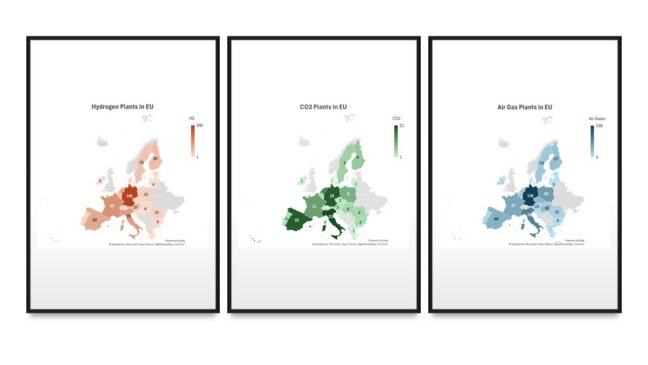
The data shows that Germany continues to host the highest number of industrial gas plants in Europe, followed by France, Italy, Spain, and the UK. This distribution reflects both the size of these economies and their strong manufacturing and healthcare sectors, which are major consumers of industrial gases.
Number of Plants per Gas:
Oxygen and nitrogen plants dominate the landscape, accounting for the majority of installations. These gases are essential for a wide range of applications, from healthcare and food processing to metallurgy and electronics. Hydrogen and carbon dioxide plants are also well represented, reflecting the growing importance of decarbonisation and the circular economy in the sector.
|
|
|
|
Registrations are open!
Registrations for the EIGA Winter Summit 2026 are now open.
"Mastering Oxygen safely" will take place in Antwerp on 28-29 January 2026.
ws.eiga.eu
|
|
|
|
EU Commission's 2026 Work Programme: Key Takeaways for the Industrial Gases Sector
The European Commission has published its 2026 Work Programme, outlining strategic priorities for Europe's industry, energy, and sustainability agenda. Several initiatives are directly relevant to the industrial gases sector, presenting both opportunities and challenges for EIGA members. Supporting Industrial Competitiveness and Innovation The Commission reaffirms its commitment to strengthening Europe's industrial base. Read More ?
|
|
|
|
COM 13/25 - Level Playing Field for Hydrogen in the Context of ETS/CBAM
EIGA urges the European Commission to proceed with the necessary regulatory adjustments so that the LPF will be restored, i.e. by ensuring that hydrogen outsourced by refineries or organic chemical installations receives the same level of FAs as if such installations would insource the production of hydrogen they consume. EIGA therefore urges the European Commission... Read More ?
|
|
|
|
COM 14/25 - ETS State Aid Guidelines / CO2 Indirect Compensation
EIGA urges the EU Commission to take this finding into account also in the context of the 2025 update of the ETS State Aid guidelines and consider extending indirect emission cost compensation to the entire industrial gas sector.
|
|
|
|
DOC 128/25 - Design and Operation of Vehicles Used in Medical Oxygen Homecare Deliveries
(Revision of Doc 128/21)
Description of basic design principles and safe operation of purpose designed vehicles, for Homecare Service Providers for delivering all modes of supply of medical oxygen and associated therapy equipment.
|
|
|
|
DOC 154/25 - Safe Location of Oxygen-Nitrogen and Argon Gas Vents
(Revision of Doc 154/16)
This publication gives a basis to determine the safe location of oxygen or inert gas vents and defines the criteria for the design of process vents to ensure the safe disposal of oxygen and inert gases. It applies to air separation and cryogenic liquefaction plants in which the venting of oxygen, nitrogen, oxygen/nitrogen mixtures, argon, or air occurs.
|
|
|
|
DOC 168/25 - Calculation Method for the Analysis and Prevention of Overpressure during Refilling of Cryogenic Tanks with Rupture Discs
(Harmonised publication)
(Revision of Doc 168/17)
This publication provides technical guidance and the complete equation set needed to determine if a particular vessel can or cannot be over pressurized during the refill operation. The calculations in this publication should be used to evaluate each pumping system and cryogenic tank combination in use with oxygen, nitrogen, or argon.
|
|
|
|
Doc 921/25 - International Harmonization Council - Work Process
(EIGA Members' area)
(Revision of Doc 921/18) This publication has been prepared by the four member associations of the International Harmonization Council, AIGA, CGA, JIMGA and EIGA. The publication details the overall Harmonization process and how each individual association manages this process. The purpose of the publication is to document the harmonization process and... Read More ?
|
|
|
|
SI 47/25 - Cleaning of Cylinders Returned from Healthcare Facilities during a Pandemic
During an ongoing pandemic, medical gas containers can become externally contaminated due to their use in health care facilities. It is important that these containers are cleaned in a manner that removes contaminants, does not cause damage to the container, valve, or gas product, and does not lead to a hazardous situation during the refilling and use of the container's contents.
|
|
|
|
SI 48/25 - The Risk of Generating Static Electricity When Using CO2 as an Inerting Gas
Precautions to avoid accidents caused by explosions which occurred while using CO2 during inerting equipment and storage tanks that had previously contained flammable materials.
|
|
|
|
SI-TS 17/25 - Implementing a Fatigue and Distraction Detection System in Delivery Vehicles
In Europe, the majority of all road accidents are fatigue- and distraction-related.
Fatigue is a human condition and nobody can fight it.
In some cases, drivers can easily recognize the first signs (yawning, blinking eyes). Despite the risk of accidents, some still believe they can fight fatigue, believe falling asleep behind the wheel cannot happen... Read More ?
|
|
|
|
TP INC 59/25 - Recent Incidents in the Industrial and Medical Gases Industry (SAC 183)
At each meeting of the EIGA Safety Advisory Council (SAC), the members exchange information on gas industry related incidents (accidents causing injuries, property or environmental damage and near-misses). SAC discusses and analyses these incidents. This information is used by SAC to determine the priorities for safety alerts, safety information, new and revised documents, campaigns etc.
|
|
|
|
|